
Buying furniture in Canada is a longer conversation than most people expect. The country’s climate swings between dry, heated winters and humid summers, and the materials sitting in your living room feel every bit of that shift. A piece that photographs beautifully in a showroom can warp, crack, or pill within two seasons if the material was chosen for looks alone.
The best luxury materials for Canadian homes earn that label twice over: they look refined and they perform. Here is a room-by-room breakdown of what actually holds up.
What Makes a Material Truly Luxurious?
Luxury is not a price tag. It is the quality of what a material does over time.
Full-grain leather develops a patina that gets richer with age rather than wearing thin. Solid oak becomes part of a room’s character rather than dating itself. Boucle wool holds its texture through years of daily use on a sofa that sees real life. These are materials that improve with time, or at the very least hold their integrity without constant maintenance.
The question to ask before buying any piece is not how it looks today. It is what it will look like in five years with regular use in a Canadian home.
What Is the Most Durable Furniture Material?
What is the most durable furniture material? The honest answer is that it depends entirely on the piece and where it lives in the home.
For frames and structural pieces, kiln-dried hardwood is the benchmark. Oak and walnut have dense grain structures that resist the seasonal contraction and expansion that Canadian humidity cycles cause. They can be refinished when the surface shows wear, which means the piece does not need replacing when it starts to look its age.
For upholstered seating, full-grain leather sits at the top of the durability hierarchy. It withstands daily friction, cleans easily, and develops character rather than deteriorating. A quality leather sofa outlasts three budget fabric alternatives and costs less over a decade when you account for replacement.
For fabric upholstery, wool-blend boucle and performance-treated weaves are the practical luxury choice. Boucle handles regular use without flattening, while performance fabrics resist staining and moisture without sacrificing the warm, textured appearance that defines a Japandi or Scandinavian interior.
What Are the Best Kitchen Furniture Material?
The kitchen and dining area are where furniture takes the most punishment. Daily meals, spills, heat, and moisture all concentrate in one space.
Kitchen furniture material for dining tables should start with solid hardwood: oak, walnut, or maple. These species handle the moisture variation of a kitchen environment better than softwoods or engineered composites, which swell at the joints and delaminate at the surface over time. A hardwood dining table with a penetrating oil finish rather than a thick lacquer coat holds up to wiping down after meals without the finish cracking or peeling.
Dining chairs in performance fabric or full-grain leather clean up quickly after use and do not trap food or odours the way loosely woven naturals can. A chair that looks polished after two years at a family dining table is genuinely a luxury product.
Best Patio Furniture Material for Canadian Outdoor Spaces
Outdoor furniture in Canada faces a different category of stress entirely. UV exposure through summer, freeze-thaw cycles in spring and autumn, and sustained moisture from rain and snow are enough to destroy most materials within a few seasons.
The best patio furniture material for Canadian conditions is teak. It contains natural oils that resist moisture, insects, and UV degradation without requiring a protective coating. Teak weathers to a silver-grey patina outdoors without losing structural integrity, and it can be oiled back to its original warm honey tone at any point.
Powder-coated aluminium is the low-maintenance alternative. The coating seals the metal completely against moisture and UV exposure, and the material itself does not rust. For cushions, solution-dyed acrylic fabric resists fading and dries quickly after rain, making it the most practical choice for Canadian outdoor use across all four seasons.
Why Canadian Made Furniture Matters for Material Quality
Canadian made furniture carries a quality signal that goes beyond patriotic preference.
Canadian manufacturers build for a climate they understand firsthand. Kiln-drying hardwood to the moisture content suited to Canadian indoor environments, using joinery techniques that account for seasonal wood movement, and selecting upholstery materials that handle the humidity swings between seasons: these are decisions that manufacturers building for stable climates simply do not need to make.
The result is furniture that fits the environment it lives in. A solid oak dining table built by a Canadian craftsman will handle a Toronto winter and a Vancouver summer differently than the same piece imported from a region where those conditions do not exist.
Choosing Luxury Materials Room by Room
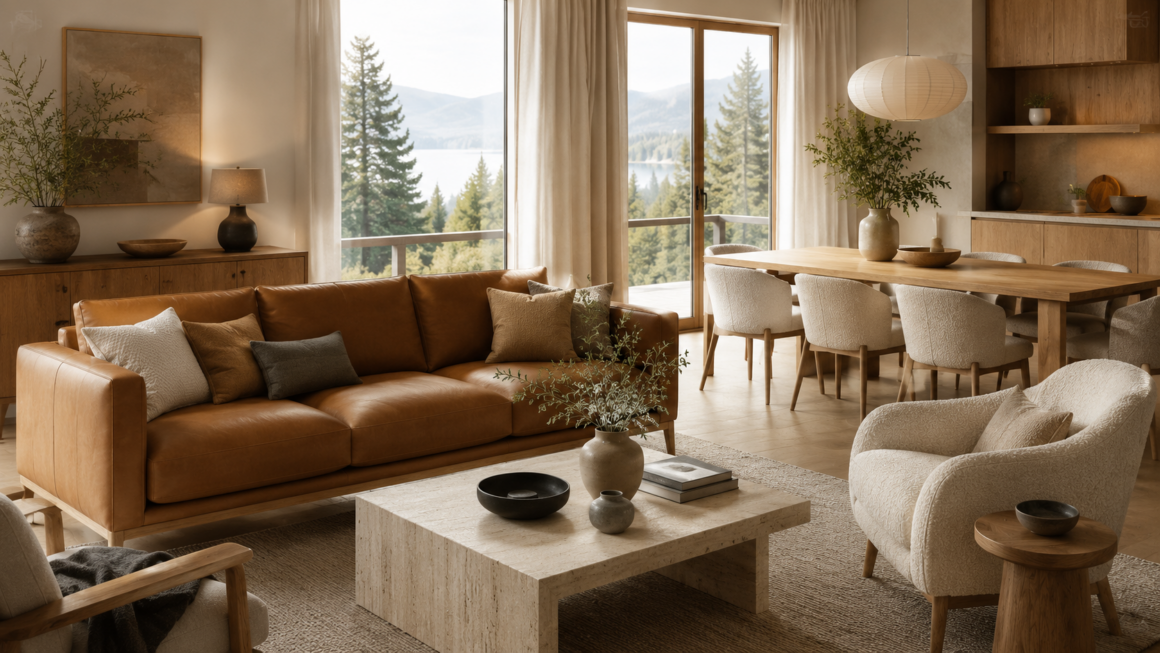
The living room is where upholstery material matters most. A sofa in wool-blend boucle or full-grain leather anchors the room with texture and warmth while handling the daily use a main seating piece faces. An accent chair in a complementary fabric adds a secondary material layer without competing with the sofa. Boucle beside linen, or leather beside a wool throw, creates the kind of layered warmth that defines a Japandi-influenced Canadian interior.
For a loveseat or compact sofa, fabric choice matters as much as form. A loveseat in a performance weave or mohair blend offers the same visual refinement as a more delicate fabric but holds up through the years of daily use that a piece in a main living space actually sees.
Across every room, the principle stays consistent: choose materials that perform as well as they photograph. In Canadian homes, that standard is not optional. It is the only one worth applying.
At Hygge Design House, every piece in the collection is chosen with this in mind: furniture built from materials that suit the way Canadians actually live, through every season and every year of use.
